







Volcanic activities on far side of moon last at least 1.4 billion years: study
The epoch-making discoveries achieved via studies of lunar rock samples retrieved by China’s Chang’e-6 spacecraft were published in the world’s leading scientific journals on Friday, revealing the volcanic activities of the moon’s lesser-known far side, which is distinct from its near side, has lasted for at least 1.4 billion years.
On June 25 this year, the Chang’e-6 lunar probe returned to Earth with 1,935.3 grams of lunar rock and dust samples collected from the previously unexplored far side of the moon.
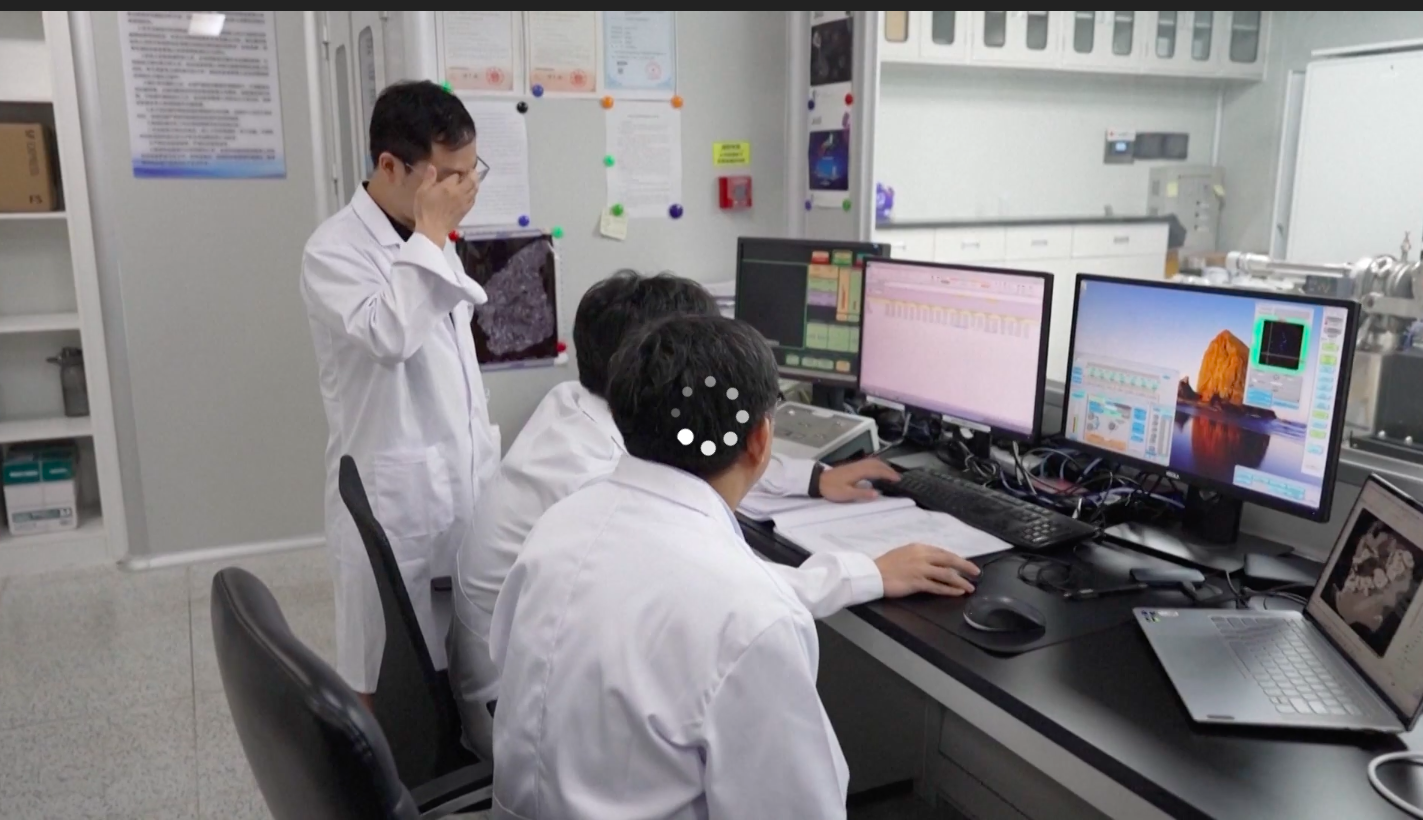
After analyzing the rock samples, researchers from the Institute of Geology and Geophysics of the Chinese Academy of Sciences (CAS) and Guangzhou Institute of Geochemistry under the CAS learned that two volcanic events occurred on the moon’s far side 2.8 billion years ago and 4.2 billion years ago, respectively, according to new studies published in the journal Nature and journal Science.
The studies also challenged the traditional belief that the thicker lunar crust on the far side of the moon prevents volcanic eruptions. However, the researchers discovered a scarcity of large volcanic rocks even in areas with a thin crust near the Chang’e-6 landing site. They suggested that other factors, such as the composition of the mantle source, may also have an impact on lunar volcanic activity.
“Previously, the moon is generally believed to turn cold faster because of its small size. By about three billion years, it may be relatively cold and it will be difficult to form large-scale magma eruptions. However, samples from Chang’e-6 and Chang’e-5 showed that after three billion years, the moon can still see relatively large-scale magma eruptions, indicating that it is still relatively hot at this time. So it undergoes some changes, compared with some understandings of predecessors,” said Zhang Le, senior engineer of Guangzhou Institute of Geochemistry.
“We also found some remnants from the impact on the moon after analyzing the lunar sample. It is also a relatively important discovery. These discoveries will be published one after another in the coming months,” said Xu Yigang, researcher of Guangzhou Institute of Geochemistry.
