










China’s Jiaolong submersible improves observation of deep-sea life
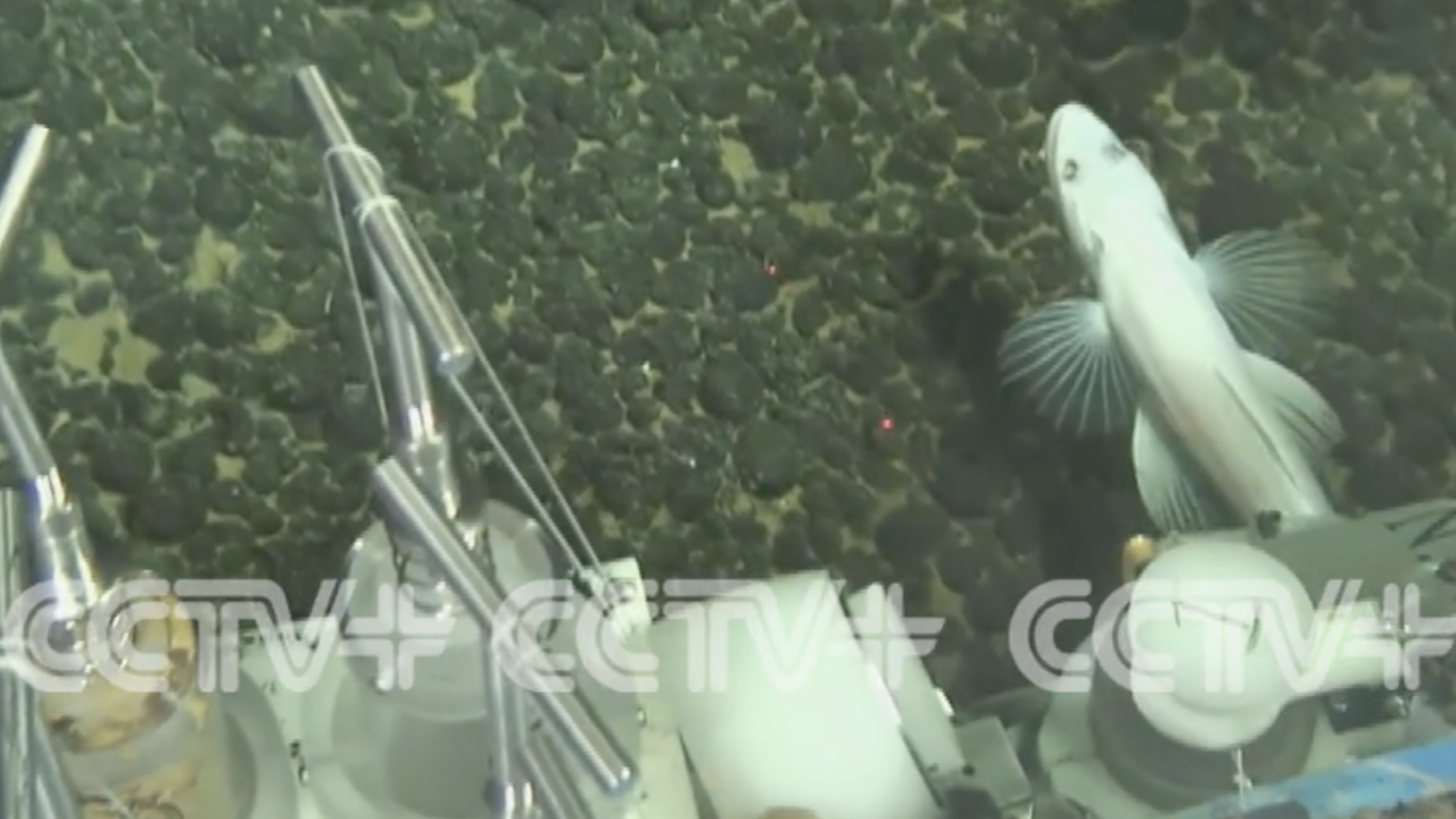
China’s Jiaolong manned submersible has recently completed experiments to improve the crew’s observation of deep-sea life by spraying a flocculant mainly composed of algae during its 11th dive of the 2024 Western Pacific International Voyage Scientific Expedition.
Submersible, deep-sea mining vehicles and other equipment would generate smoke-like plumes if they stir up sediments on the seafloor during operation, causing turbidity in water which will negatively impact the observation during exploration and even cause disturbance for the ecosystem of deep-sea animals and their habitats.
To reduce the impacts of the sediment plumes, scientists on the Jiaolong manned submersible conducted experiments. They used materials and technology independently developed by Chen Xuguang, a professor from the Ocean University of China, to grapple with turbidity in water caused by sediment plumes and their dispersal.
They sprayed a flocculant mainly composed of algae towards flumes to make it flocculate to form large particles of flocs and settle back to the seafloor in a few minutes, reducing the adverse influence of exploration on the deep-sea environment.
Three experiments of this kind were carried out in different environmental conditions during the 11th dive of the Jiaolong manned submersible. After these experiments, the crew could better observe deep-sea life than they did in previous dives.
Jiaolong is China’s first independently designed and integrated 7,000-meter-class manned submersible and set a diving record of 7,062 meters in the Mariana Trench in June 2012.
The International Voyage Scientific Expedition, estimated to last for 45 days, is organized by the China Ocean Mineral Resources Research and Development Association under the Ministry of Natural Resources and implemented by the National Deep Sea Center. One of the highlights of the expedition is that, Jiaolong, for the first time, is scheduled to carry eight international scientists for underwater operations.
